



City staff set to battle wild parsnip this spring
Special to WC Online
OTTAWA – A summer tradition for City of Ottawa Public Works staff, the department has released its plan to battle wild parsnip this summer.
The battle started May 19 according to a memo to council relased by Public Works general manager Alain Gonthier on May 7
Wild parsnip is an invasive plant that is increasingly common within Ottawa and may pose a health risk to humans. The plant sap contains chemicals that may cause skin and eye irritation and make the skin prone to burning and blistering when exposed to the sun.
“The goal of the program is to reduce the growth of wild parsnip in highly infested areas while ensuring environmentally sensitive areas and public safety are not adversely impacted,” Gonthier wrote in the memo obtained by West Carleton Online.
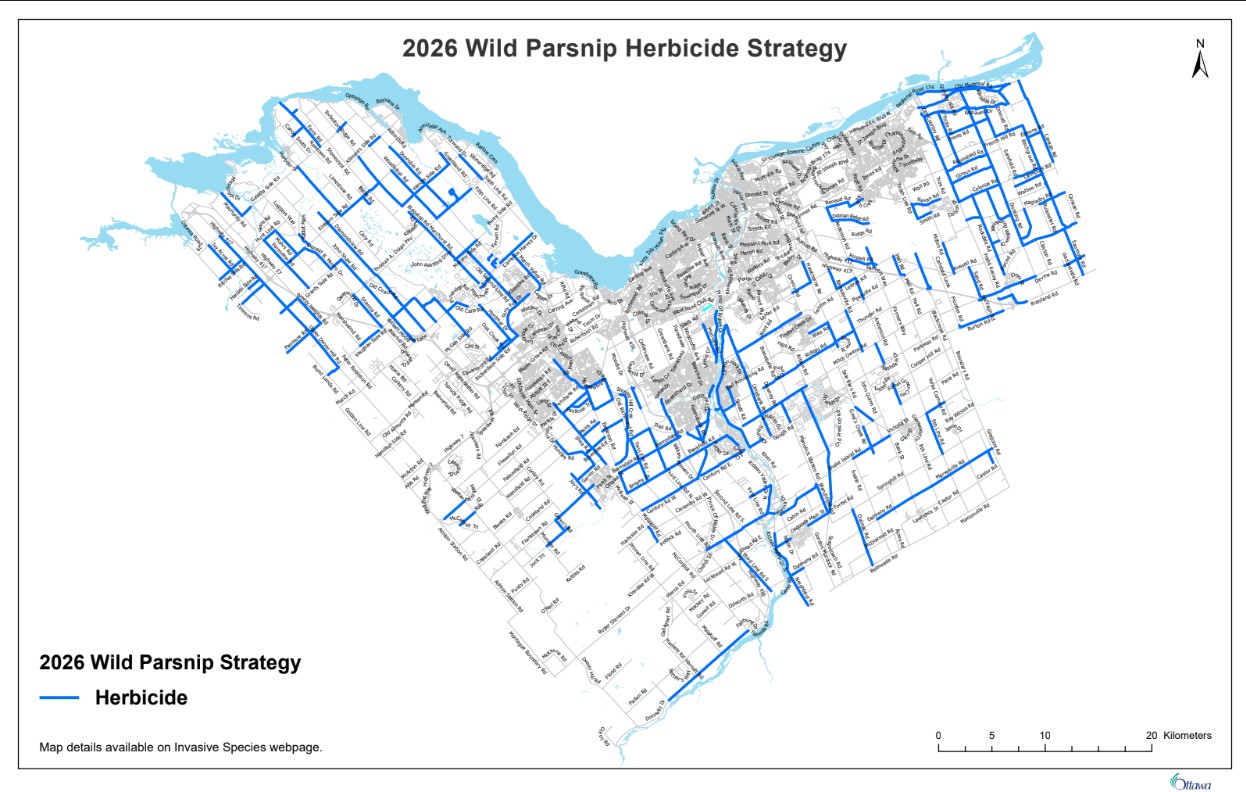
Approximately 1,400 lane kilometres of roadsides, and several parkland locations will be treated this year.
“Further information about park locations for treatment will be shared in early June, and additional herbicide application may be considered again for the fall season,” Gonthier said. “Every year, staff receive feedback from residents and councillors that additional treatment is required. Since 2024, the city has significantly increased the number of lane kilometres treated annually within existing budgets.”
In total, council has approved $298,000 for this year’s strategy.
“Public Works will continue to assess the required resources and budget for spraying operations in future years,” Gonthier said. “The 2026 Wild Parsnip Strategy will be managed by Roads and Parking Services and Parks Maintenance and Forestry Services.”
Through the strategy, staff will: map infestation areas and levels; continue the communication and awareness campaign in collaboration with partners including Ottawa Public Health, the Ministry of Environment, Conservation and Parks, National Capital Commission, etc.; and prepare communication materials for councillors to share with residents.
For roads, the program will continue and expand the application of Clearview and Navius FLEX herbicides to highly infested roadside areas; and continue mowing operations, adjusting frequency and timing to best coincide with herbicide applications roadsides.
For parks and public spaces staff will continue mowing operations as a primary mitigation strategy; continue hand pulling smaller infestation; per provincial legislation, continue application of Clearview and Glyphosate herbicide only when necessary; and post signage indicating locations where spraying occurs including larger infestations in naturalized areas.
To notify the public of the herbicide application, a Ministry of Environment, Conservation and Parks approved Notice of Herbicide Use advertisement will appear in local newspapers one week prior to the start of spraying and throughout the summer.
“Councillors will be informed in advance if spraying occurs in parks or public spaces in their wards,” Gonthier said. “Rural residents who do not wish to have the roadside adjacent to their property sprayed have been given the option to opt-out of the Wild Parsnip Program. Should a resident optout of the program, it will become their responsibility to manage any wild parsnip infestation adjacent to their property, as required by the Weed Control Act, 1990.”
Information has been shared on how to opt-out as part of the communications to residents on Ottawa.ca and in print materials.