



Wind phone connection to those we lost
By Nonie Smart - West Carleton Online
KANATA – Last month Hospice Care Ottawa (HCO) announced their plan to build Ottawa’s second wind phone – a sacred space for remembrance, reflection and healing.
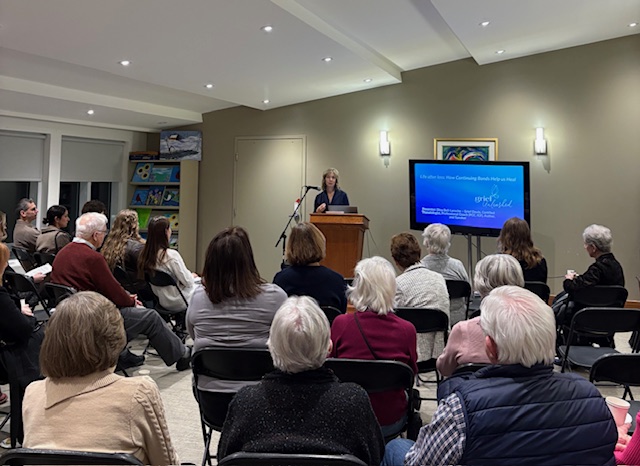
On a chilly winter evening (Feb. 17) HCO board chair Lynne Toupin welcomed roughly 30 attendees to the Ruddy-Shenkman Hospice (110 McCurdy Dr.) to launch the fundraising campaign.
“The concept of the wind phone was first imagined in 2010 by Japanese gardener Itaru Sasaki on the death of a beloved cousin,” Toupin said. “Overcome with sorrow he placed a disconnected old rotary phone inside a small glass phone booth in his garden. From here he would ‘call’ his cousin and speak to him as though he were still alive, his words carried by the wind. What began as one man’s personal way of processing grief, soon became something much greater. People travelled from near and far drawn by the simple yet powerful opportunity to speak words often left unsaid.”
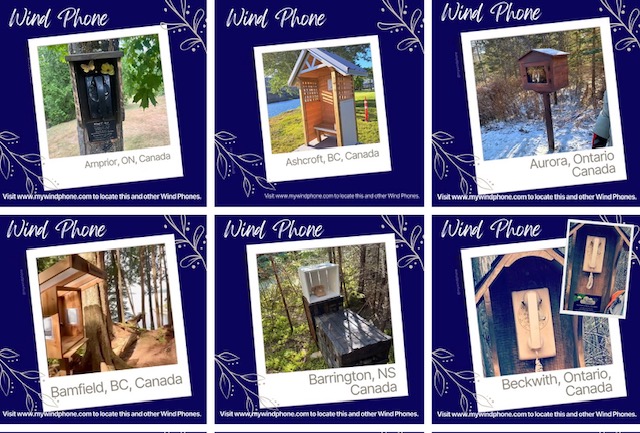
Today there are more than 500 wind phones around the world and roughly one quarter of those are in Canada.
“For HCO the wind phone is a natural extension of our commitment to caring,” Toupin said. “We know that grief does not end when a life does and our support for families does not end there either. It will ensure anyone carrying loss has a place to go, a place to speak and a place to feel connected. The wind phone is a good example of how one person’s struggle can inspire something that supports an entire community.”
“Great things are possible when compassion brings people and organizations together,” Toupin said as she introduced the evening’s guest speaker Dina Bell-Laroche who is the visionary behind this project. “Dina is someone who deeply understands firsthand the importance of creating spaces where grief can be expressed and where connection with a loved one can be continued. She has transformed her personal grief journey into one of service, helping others feel less alone and reminding us that love does not end with loss.”
Bell-Laroche’s personal grief journey began with the untimely death of her 29-year-old sister Tracy.
“When Tracy died, my entire world changed,” she wrote of her sister’s passing her recent book Grief Unleashed (2023).
“We are here to honour someone who continues to enrich our lives and that is my sister Tracy, my mom’s second daughter,” Bell-Laroche said. “She is ever present but tonight even more so because on this day 25-years-ago she passed away. Grief is here to teach us and humble us in the face of our loss. We need to learn to invite grief in to the room and it will do its work.”
Bell-Laroche has honored her sister’s memory with decades of charitable works including starting Tracy’s Hope a non-profit charitable organization and supporting the non-profit agency SchoolBOX. In doing so, she says they have found surprising ways to keep Tracey’s memory alive.
“I could not, not stay connected with her,” she said. “As a bereavement specialist, I now know that I was enacting these continuing bonds that I didn’t have language for at the time. When someone dies where does all that love go?”
Bell-Laroche, a certified thanatologist (one who specializes in death, dying and bereavement) says the wind phone is a beautiful idea.
“Your attachment to your person is unique to you, sort of like a fingerprint,” she said. “We need to understand that grief is our internal response to loss. Part of what we want to do here this evening is to normalize a natural human experience that all of us navigate. If we are given permission to speak our truth and not hide or suppress our experience, we can find a true community like this. And when we have tangible things like the wind phone, we can have a place where people can have a safe refuge. When we also have beautiful spaces like HCO that welcome people and dignify the dying experience then there is hope.”
Everyone has a grief story according to Bell-Laroche.
“I hope you walk away from this evening feeling a little less isolated and that you learn something helpful,” she said. “Maybe you will feel a bit relieved. Often when I do grief companioning people are relived, even surprised. It’s like, ‘Oh I have permission to express, not suffocate, this anguish that is surfacing inside of me’. Yes, permission granted. If I have one hope it is that you become more self-compassionate and that you understand coping differently is okay.”
Four years ago, Bell-Laroche discovered the concept of a wind phone and enlisted the help of Maple Leaf Custom Homes builder Brian Saumure to bring the first one to Ottawa. At the time there were only 12 wind phones in Canada.
“It’s on the beautiful lands of the Ottawa Cancer Foundation,” she said. “Cancer survivors and their loved ones often find refuge in this beautiful space to process the grief of what will no longer be, and all of the different things when life goes sideways.”
Now that a wind phone is available in the middle of the city, Bell-Laroche decided it was time to install Ottawa’s second wind phone in the west end.
“We walked the grounds of Ruddy-Shenkman Hospice and found a space we are very excited about,” she said. “This wind phone project is launched in honour of all of you, here tonight that have suffered through pain and loss and that which is yet to come. In the meantime, we have learned to live. What I have learned in connecting with my grief is that there is a lot more room for joy. We get busy living when we are not suffocating our grief. So, what is continuing bonds? It is this holistic theory that really invites us to meet our grief from a place of grief.”
The continuing bonds theory was proposed in 1996 and it encourages the bereaved to maintain a connection with lost their loved one in new ways.
“The beautiful energy of, ‘just because someone dies’ doesn’t mean the relationship with them has to die too,” Bell-Laroche said. “I don’t have to put this person behind me as if they never existed. Not to feel like we have to move on, faster. And some of what we have been sharing with you as a tangible expression of our grief is having a place that gives us permission to express our grief. Continuing bonds just allows us to acknowledge that our grief does not have to be cast aside and that our story of loss and love does not have to be forgotten. We can write a new story with the people we still hold dear in our heart.”
After the presentation Bell-Laroche told West Carleton Online a little bit more about how a public-access wind phone will be an important community resource for the bereaved.
“Usually, healing begins with ritual and people connecting to community,” she said. “If my grief is not invited or publicly recognized or socially acceptable, where do we go? The pain does not disappear. When it is suppressed, it calcifies and hardens, and we know that grief is energy that needs to be expulsed from our body. Most of the time we need a community that says we love you and we are here. A wind phone is a symbol of that. It is a public symbol where we are saying bereavement cares, there is a place here where we can normalize this. Come and have a conversation with your person or yourself.”
Bell-Laroche says engaging with a wind phone just might be worth a try.
“As a grief professional I know about healthy and healing coping practices,” she said. “Sometimes a symbolic ritual such as stepping into a space that is really devoted to honour your grief may be helpful. But if it’s not at least you have tried something. What’s the harm in stepping in and dialing your person’s phone number the old school way and then having a conversation. What was the last thing you said to your person? Do you have any regrets? Are things that you want to share?”
To help the the wind phone initiative reach its goal of $10,000 donations can be made online at www.wind-phone-fundraiser.raiselysite.com/donations. For more information on Hospice Care Ottawa see: www.hospicecareottawa.ca.