




Longworth: When a passport isn’t enough to travel
By Richard Longworth for West Carleton Online
For most of my adult life, I have thought of myself as Canadian.

I came to Canada from England in 1956, built my life here, worked here, raised my family here, and like many others in West Carleton, I carry a Canadian passport with pride. So, when I planned a visit to England, I assumed the process would be straightforward. Book the flight; pack the suitcase; carry my Canadian passport; and go.
I was wrong.
What I discovered, rather late in the process, is that being born in the United Kingdom can create unexpected complications under the UK’s newer travel authorization rules. The issue is not that Canada is suddenly unwelcome, or that Canadian travellers cannot visit Britain. The issue is more specific, and much more confusing. If you are considered a British citizen, even if you have lived in Canada for decades, you may not be treated simply as a Canadian visitor.
Under the UK’s Electronic Travel Authorisation (ETA) system, many foreign visitors need an ETA before travelling to the United Kingdom. But British citizens do not need an ETA. That sounds simple enough, until you realize the practical problem. If you are British by birth, but you are travelling only on a Canadian passport, the airline or border system may expect you to prove your British status with a valid British passport or equivalent documentation. The UK government guidance says British dual nationals should travel with a British passport, Irish passport, or another passport containing a Certificate of Entitlement to the Right of Abode.
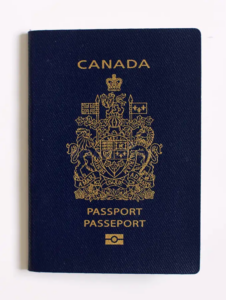
In plain English, this means that a Canadian passport may not be enough for someone like me if the UK still regards that person as British.
That is a surprising position to find oneself in. I am Canadian. I have lived in Canada since the 1950s. Yet my birthplace may determine what travel document I am expected to carry when returning to the country where I was born.
My immediate problem was practical and stressful. I had an Air Transat flight booked from Toronto to Manchester. My travel dates were approaching quickly. I believed I needed an ETA, but my application was pending, and there was no guarantee it would be approved in time. Then I learned that if I am considered a UK citizen, I may not be eligible for an ETA at all. The very document I thought I needed might not be the correct solution.
That left me in a difficult position. Would I be allowed to board the flight in Toronto? Would the airline refuse me before I even reached Manchester? If I did arrive in the UK, would I face difficulty at the border? These are not theoretical questions when a flight is days away and a fare has already been paid.
What makes the situation especially frustrating is that many people affected by this rule are not frequent international travellers. Some are seniors. Some left Britain as children. Some may have no current British passport and no recent reason to think they needed one. They may have travelled for years using a Canadian, Australian, New Zealand, or other passport without difficulty. Then suddenly, a planned family visit, funeral, holiday or reunion becomes an administrative puzzle.
This is where the system feels less human than it should.
A passport is supposed to simplify identity. But in this case, identity becomes layered: Canadian by life, British by birth, perhaps dual by law, and uncertain by airline checklist. For ordinary travellers, especially older adults, the distinction between citizenship, nationality, right of abode, ETA eligibility, and passport documentation is not easy to untangle.
There is also a communication problem. Rules may be posted online, but ‘posted online’ is not the same as clearly understood by the people who need to know. A senior who left Britain 70 years ago may not think to search for “dual national right of abode certificate” before booking a flight. A person may reasonably assume that a valid Canadian passport is enough for a short visit to England.
My purpose in writing this is not to criticize border security. Every country has the right to manage entry requirements. My concern is the rules need to be communicated in a way that ordinary people can understand before they buy tickets, book hotels, arrange family visits and risk losing money.
There are a few lessons I would pass on to readers.
First, if you were born in the United Kingdom and now travel on a Canadian passport, do not assume the rules are the same as they were years ago. Check your status well before travelling.
Second, do not assume applying for a UK ETA is the answer. If the UK considers you a British citizen, you may not be eligible for an ETA because British citizens are not the intended users of that system.
Third, contact the airline before travel and ask specifically what documentation they require for a UK-born Canadian citizen travelling to Britain. It is often the airline that decides whether you board the aircraft in Canada.
Fourth, consider applying for a British passport if you are entitled to one and expect to travel to the UK again. That may be simpler in the long run than facing uncertainty before every trip.
Finally, start early. Government systems do not always move at the speed of family life.
For me, this experience has been a reminder that modern travel is no longer just about distance. It is about documents, databases, rules, and timing. A person can have a valid passport, a paid ticket, and a sincere reason to travel (as in my case), and still find themselves caught in a confusing gap between two countries.
Many of us in Canada have roots elsewhere. We may think of those roots as family history, memory, or heritage. But sometimes those roots still have legal consequences.
That is the lesson I learned the hard way and as I found many others have also been affected.
And it is a lesson worth sharing before someone else finds themselves at the airport, suitcase packed, ticket paid for and unsure whether they will be allowed to board.