





Mayor says ‘no easy answers’ to flooding
By Jake Davies - West Carleton Online
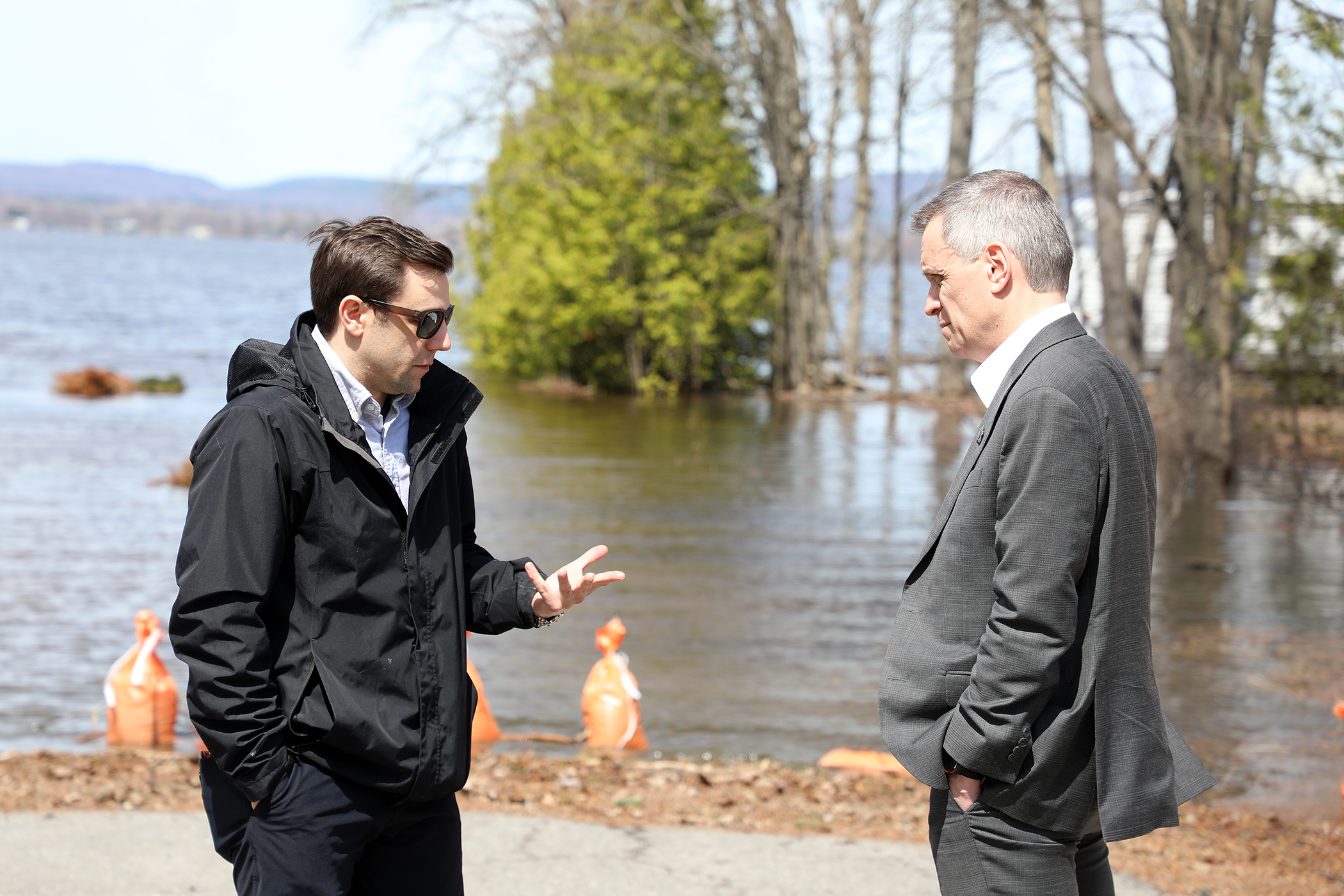
CONSTANCE BAY – City of Ottawa Mayor Mark Sutcliffe visited Constance Bay today (April 23) to get a firsthand look at Ottawa River flooding and the damage it has caused to the community.

It’s the third time in the last four years he’s visited Ward 5 during the spring freshet. While Sutcliffe admits the current response can’t go on indefinitely, he doesn’t have a long-term solution either.
The mayor and his team arrived at the Constance Bay community centre shortly after noon where West Carleton-March Coun. Clarke Kelly was already waiting to greet him and update him on the situation.
The good news is Ottawa River levels are expected to drop slightly over the next 24 hours.
The mayor and Kelly greeted and thanked the small group of volunteers on hand filling sandbags – two groups were from two Ottawa-based companies made up of staff who came down to Constance Bay to help out. There were a couple of local residents filling bags for their fellow community members as well.
There was a large pile of sandbags, numbering in the thousands, filled and ready to go towards supporting the community.
Following that, Sutcliffe and Kelly took a drive around Bayview Drive, a road that is regularly one of the hardest hit areas in Constance Bay by Ottawa River flooding.
Kelly told the mayor about gas shutoffs, septic and clean water issues and other challenges created by the flooding. Some houses, on both sides of Bayview Drive, were completely surrounded by river water. Others were high and dry.
Bayview Drive itself was starting to show the wear and tear of being assaulted by floodwater every year or so.
While Thursday, April 23, might not be the time to tackle a long-term solution to fairly regular flooding in West Carleton since 2017, it doesn’t hurt to start the conversation.
“First and foremost, we have to support the people as they are going through this, as we have every year,” Sutcliffe told West Carleton Online just beside the sandbagging station at the Constance Bay community centre. “The team is in place, they’re ready to go. The volunteers are amazing. So, we have to continue to do that. Going forward, it’s very challenging. People own property, and the climate and environment have changed, and these events are happening more frequently. There are no easy solutions for the people who own property where the water is rising more than it has in the past. We’re ready to work with the residents and work on solutions long term. But there are no easy answers to a challenge like this.”
Sutcliffe says the city hasn’t looked for funding from the province at this point, but that hasn’t been ruled out either.
“We haven’t asked for any funding from the province yet,” he said. “I don’t think it’s at the level that would be warranted. If it does get to that level, I will call the premier (Doug Ford) directly and I am sure he will be responsive.”
Future planning is a path forward that may prevent the flooding issue from growing bigger.
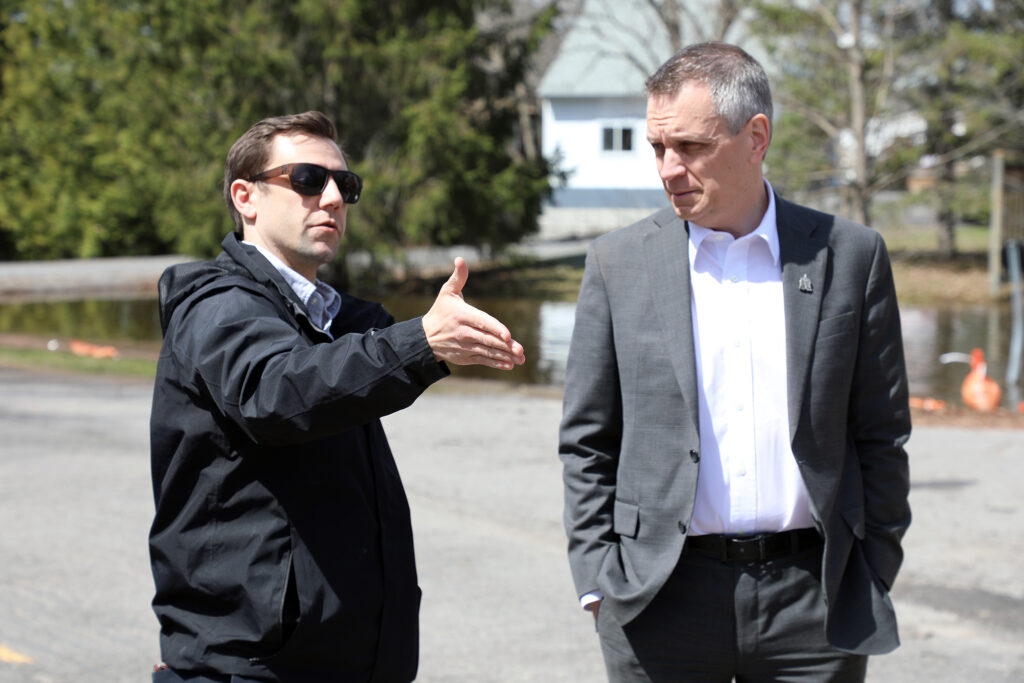
“Going forward, obviously we are going to have to look at where new housing is being built,” Sutcliffe said. “Make sure it is not in areas that are more likely to be flooded than maybe they were 10 years ago, 20 years ago, 30 years ago. I think that’s one of the main things we can do moving forward. But it’s still challenging when there were houses built long before the climate changed and the water levels started rising. We’re going to have to find solutions for those property owners as well.”
Sutcliffe won’t rule out Quebec’s response following 2019 flooding where the province bought out property owners in flood-stricken areas and prevented future builds for any home builders in those areas but admits that’s a hard pill to swallow.
“Anything is possible,” he said. “I don’t think we’re at a stage of proposing specific solutions like that and I don’t know if that’s what the residents themselves want. I know I’ve talked to some residents who want to stay in their homes, they don’t want to move. It’s not easy, but we’ll keep looking at what’s possible. It’s an amazing area. It’s wonderful.”
But the challenges are obvious.
“This is the third time in this four-year term that we’ve been together that we’ve responded to flooding,” Kelly said of the frequency.
“That’s too frequent,” Sutcliffe said. “But we’re here to support everybody and get them through the next few weeks and on to enjoying their waterfront in the summer.”
Currently, the Ottawa River Regulation Planning Board (ORRPB) says the river is stabilizing.
“Water levels and flows have stabilized between Pembroke and Lake Deschenes and are stabilizing between Gatineau-Hull and Carillon at levels five to 15 centimetres below peaks experienced on May 4 and May 5, 2023,” the ORRPB released in a statement yesterday (April 22) afternoon. “With moderate temperatures forecast and no major precipitation expected in the next few days, spring runoff from the central unregulated portion of the basin is expected to gradually decrease over the coming week. During the same period, increasing spring runoff from the partially regulated Abitibi-Timiskaming area will gradually make its way down the main stem of the Ottawa River, with water levels and flows between Mattawa and Pembroke expected to continue increasing until they stabilize later on.”
Minor flood levels in Mattawa could be exceeded starting this afternoon (April 23).
“The rate of decline in flows and levels from Lake Coulonge to Carillon over the coming weeks will depend on weather,” the ORRPB said. “Risk of further increase in levels in late April and early May due to high spring runoff from the northern portion of the basin is higher from Mattawa to Lake Coulonge.”
Yesterday, levels at Brittania were measured at 60.25 meters. The ORRPB forecasts that will drop to 60.2 m by Saturday, April 25.
At Chats Lake, the levels were measured at 75.8 m. The ORRPB expects that will drop to 75.75 m by April 25.




“Mayor says ‘No Easy Answers’ to flooding”
I agree that there are no quick and easy solutions to address the flooding impact on residents of West Carleton-March, but there are ways to mitigate the impacts. I’d recommend that the City setup one or two meetings with the residents to help them identify solutions. As an impacted resident, I made some changes to my property in 2017 to help address the impacts. It is important that the City move towards being more resilient for the increasingly frequent impacts of Climate Change.
The city probably doesn’t want to be dealing with the yearly flood impacts on a regular basis, and everything that can be done to mitigate this would be in their best interest. For example, in 2020 (March 5th) the City of Ottawa staff recommended that many of the flood impacted roads in West Carleton-March be raised in order to permit residents, emergency vehicles, and heating fuel vehicles to access homes. Many emergency management agencies recommend this be done to mitigate flood impacts. It would be nice if the City of Ottawa implemented this as a mitigating solution, as it is six years since this report. The Federal Government also had a grant supporting this.
Houses could be raised, protected with retaining walls, and even out-right purchase of the homes in certain cases to relocate these people out of the flood zone. Stone wall against debris could be setup on the property to reduce the garbage and refuse that deposits each year on properties. This would obviously require permission from the conservation authorities to allow residents to protect their property.
Hopefully this flood will lead to increased communications with the three levels of Government to move toward making West Carleton-March more climate resilient for the future.
So yes, it’s not easy, but there are things that could be done. My recommendation is that the city reach out to the flood impacted residents to get some ideas.
Bruce Collier
Resident of Willola