





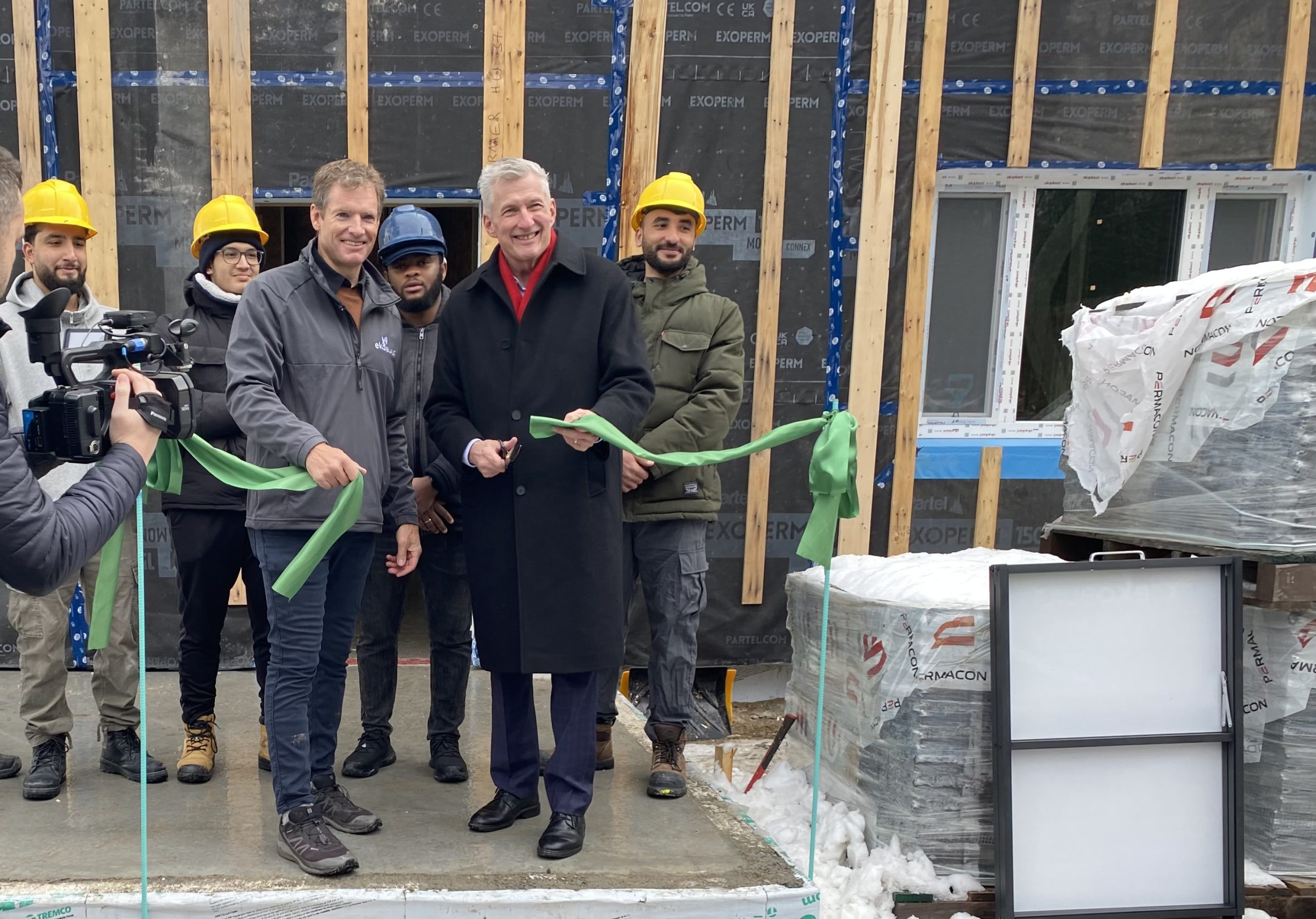
EkoBuilt unveils passive Dunrobin house
By Nonie Smart - West Carleton Online
DUNROBIN – Move over drafty old farmhouse, new air-tight homes are on the way.
An Ottawa company says it can build homes that use one-tenth of the energy needed for heating and cooling, thus saving families thousands of dollars in energy costs per year. Last week (Nov. 25), EkoBuilt founder and CEO Paul Kealey showed how this is done at a mid-morning ribbon cutting ceremony by the shores of the Ottawa River near Dunrobin.
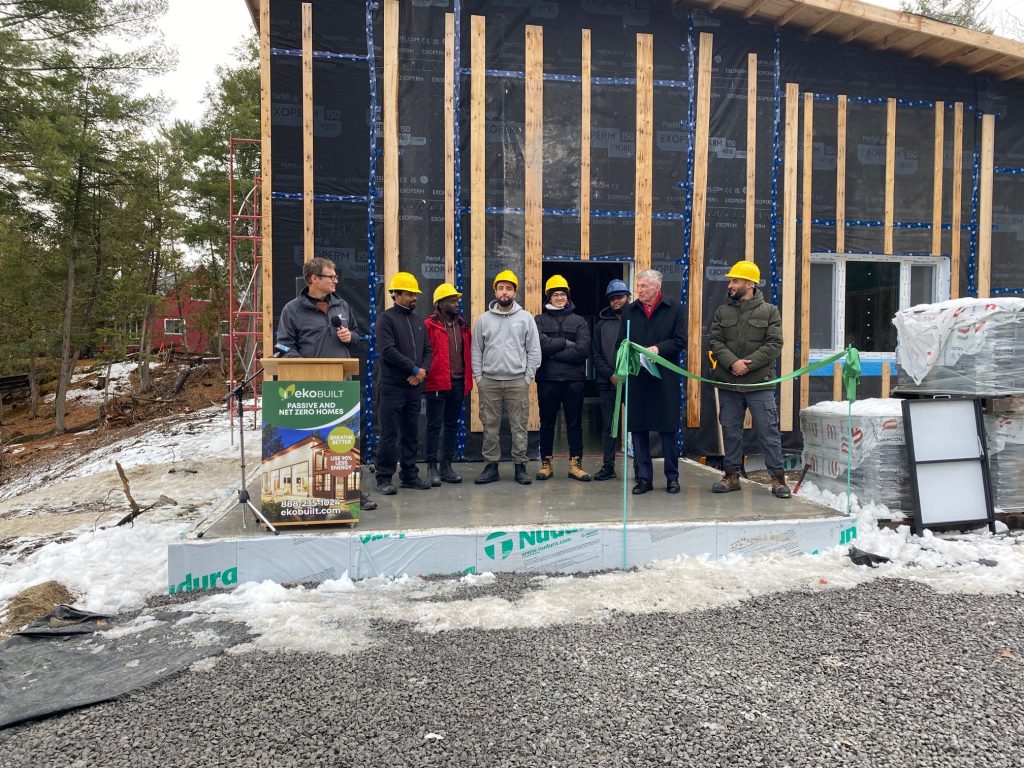
“This building is a brand new pre-fabricated passive house,” Kealey told a small group of dignitaries, media and construction workers gathered for the unveiling of the passive house building envelop – essentially the walls and roof of the outer shell.
A passive house is an ultra-energy-efficient building that requires up to 90 per cent less energy use for heating and cooling. This is achieved by using airtight construction, insulation and high-performance windows to eliminate air leaks along with heat recovery and fresh air ventilations systems.
Kealey says EkoBuilt can complete a weather tight installation (outer shell) in four days which requires roughly 30 to 50 pre-fabricated wall and roof panels depending on the size of the home. The cost of construction is approximately $350 per square-foot ($560,000 for a 1,600 sq-ft home, or 148 square metres) including finishings but this total does not include expenses such as land, project management, permits and so on.
The use of pre-fabricated panels cuts building time in half and also significantly reduces material waste, Kealey says.
“This house will take roughly six months to build, about half the time of a site-built home,” he said. “Any builder, company, team of carpenters can produce up to 10 times more houses per year as compared to on-site construction. It has been built precisely, indoors out of the weather, with automated equipment and high-performance detailing that dramatically reduces waste.”
Passive house construction eliminates drafts and risk of mold as well as ensuring stable temperatures, low humidity, and clean filtered air.
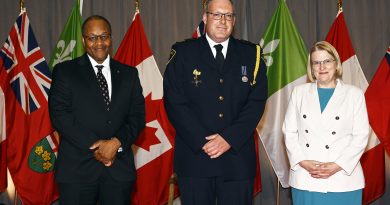
“Yes, a high-performance home will cost more to build,” Kealey said. “Our goal is to offset that incremental cost with savings in energy and utilities. The payback begins as soon as the family moves into the home.” Carleton MP Bruce Fanjoy, on hand for the ribbon cutting, said the Government of Canada supports these goals. As such EkoBuilt has recently received a $1 million FedDev Ontario investment to install specialized equipment and an advanced new production process for its energy efficient prefabrication facility.
“These improvements will allow the company to quickly produce their ready-made wall and roof panels that are optimized for the North American climate,” he said. “These products can be easily used by builders and developers and can be adapted for many types of housing. Prefabrication is how we build homes faster, better, more affordably and in a climate like ours, it fills the construction season. For the first time you will be able to fully construct homes year-round in Canada.”
Kealey said legacy is one the biggest reasons why these land owners chose to build a passive house.
“Although they could not be here today, they sent a message that captures the heart of this project,” he said. “They wrote the property has been in the family for over a century. They said they chose to build a passive house so it can be passed down from generation to generation without each generation needing to fix it just to make it livable.”
Kealey also recognized students participating in the YMCA home building program as being the generation that will transform construction in this country.
“You are stepping into one of the most important parts of home building in over a century,” he said. “You are not just learning carpentry, design or building science, you are learning what the housing crisis is all about, climate resiliency, energy affordability, healthy indoor environments and how to build a home that will last for generations.”
Build once, build properly and build for the future says Kealey.
“This is more than a structure,” he said. “It is a promise that we don’t have to wait for the future to be built better. We can do it today. This is the house of now. It represents a brighter, healthier, and more resilient path forward for families and communities across Canada.”



I am curious what type of windows they will be using.